

Sit through five B2B sales calls in a week and you’ll start finishing the reps’ sentences before they do. Everyone is “purpose-built.” Everyone has “enterprise-grade security.” Everyone claims to be the platform teams “actually enjoy using.” The words are interchangeable because, underneath them, the products often are too.
This is already happening across most B2B markets. Products are getting built faster, competitors can copy features pretty quickly, and prices tend to start looking similar once a market settles down. At that point, having one more feature isn’t necessarily going to win the deal. What matters is which company buyers feel more confident choosing. That’s where brand differentiation starts to matter. It’s less about adding to the feature list and more about giving people a reason to choose you when the products look pretty similar.
Why the old playbook stopped working
There was a time when having a genuinely better product was enough to get noticed. B2B buyers could see the difference, and they didn’t have thousands of reviews, comparisons, demos, and competitors to look through before making a decision. Today, that’s a very different situation.
Buyers now research on their own terms, and they don’t trust vendors to tell them the truth about themselves. They’re leaning instead on peers, review sites, and increasingly, AI tools that summarize a market for them, then fact-checking whatever those tools tell them. TrustRadius’s 2026 B2B Buying Disconnect Report, based on nearly 1,900 technology buyers, found that 94% of buyers who used AI during a purchase said they fact-check its output at least some of the time.
Every buyer doing that fact-checking is comparing your claims against a competitor’s nearly identical claims, often without ever speaking to your sales team.
Put simply: buyers have more ways than ever to discover that most vendors in a category sound the same, and less patience for it. Standing out on paper isn’t enough. You need to be the brand that’s remembered, trusted, and easy to say yes to when the specs are a wash.
Feature parity isn’t a failure, it’s the default
There’s a useful, slightly uncomfortable idea from marketing researcher Byron Sharp that’s worth internalizing here: differentiation based purely on product attributes is nearly impossible to sustain. Someone will match your feature within two release cycles. What’s much harder to copy is how a company shows up, who it serves best, what it believes about the problem, and how consistently it delivers on that belief across every interaction a buyer has with it.
Of course the product matters. But being a good product isn’t always enough when there are three, four, or ten other options that look pretty good too. 6sense’s 2025 Buyer Experience Report puts this into perspective: in about 80% of cases, the vendor a buyer prefers at the end of their research is the one they eventually buy from. And that preference is often there before a salesperson enters the picture. This is why brand differentiation happens long before someone sees a feature comparison. It happens as buyers form an opinion about who they want to work with.
Where differentiation actually shows up now
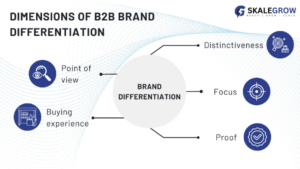
A point of view, not a pitch
The B2B brands that get remembered usually have an opinion about how the work should be done, not just a product that does it.
- Challenge a common assumption in your category instead of restating it
- Publish research nobody else has bothered to run
- Say “most companies get this part wrong” and actually explain why
Generic thought leadership doesn’t do any of this. Edelman and LinkedIn’s own 2024 B2B Thought Leadership Impact Report found that more than three in four decision-makers and C-suite executives said a piece of thought leadership had prompted them to research a vendor they hadn’t previously considered, but only 48% rated the overall quality of the thought leadership they read as good. That gap between influence and quality is exactly where a distinct point of view earns its keep.
The experience around the sale
B2B buyers notice the experience just as much as the product itself. They notice how easy it is to find information, what happens when they ask for a demo, and what the sales process feels like once they get there. A few small things can tell them quite a lot:
- You want to book a demo, but first you have to fill out fifteen fields.
- The sales call feels more like answering questions than having an actual conversation.
- Documentation that’s written in a way that makes sense to a lawyer, but not necessarily to the person who just needs to get something done.
When two vendors are offering pretty similar products, the easier one to deal with can have a real advantage. That starts with the buying experience. And increasingly, the buyer isn’t even the only one judging it. G2’s 2026 Answer Economy report found that 69% of buyers ended up choosing a different vendor from the one they had originally planned to use because an AI chatbot recommended it. The report also found that a third bought from a vendor they’d never heard of before they started looking. So having clear information and a straightforward buying process matters for more than just the person on the other side of the screen. It also makes it easier for AI tools to understand and recommend your company.
Consistency people can recognize without your logo
This is the part most B2B companies underinvest in. Distinctiveness, the visual and verbal cues that let a buyer identify you at a glance, is a different discipline from differentiation, but it’s just as important.
A buyer shouldn’t have to wonder whether they’re looking at the same company when they move from your ad to your website to your sales deck. Everything doesn’t need to look identical, but there should be something familiar running through it. Maybe it’s a particular color, the way you explain a problem, or just the voice you use when you write. Those details get remembered after people see them enough times.
Who you refuse to be
Trying to speak to everyone usually makes the message harder to remember. The B2B brands that stand out tend to know who they’re really trying to reach and, just as importantly, who they’re not trying to work with. That can feel a little uncomfortable at first because it means turning away from some potential customers. But when you know exactly who you’re talking to, the message usually becomes much clearer.
Proof that isn’t self-reported
With buyer trust in vendor claims at a low point, differentiation increasingly comes from evidence you don’t control the narrative on:
- Customer stories told in the customer’s own words, not a marketing team’s paraphrase
- Third-party reviews buyers can cross-check against each other
- Data you’re willing to publish even when it isn’t flattering

Buyers are more persuaded by what your customers say about you than by what you say about yourself, and that gap is only widening as skepticism toward AI-generated and vendor-generated content grows. The proof buyers trust most is often happening without the vendor in the room, in conversations and reviews you don’t get to shape.
Finding your version of it
There’s no formula that spits out a differentiator, but there is a useful test:
- Pull your last ten lost deals and your last ten renewals
- Write down what those customers actually said about you, not what your team assumes they thought
- Look for language that keeps repeating across both lists
It may not be a feature that makes someone choose you. Sometimes it’s the experience they had, how quickly your team understood what they needed, or simply the feeling that they could trust you.
It’s also worth looking at what your competitors are saying. Put their websites next to yours and see how much of the language could be swapped around without anyone noticing. If the same claims could sit on either homepage, they probably aren’t giving buyers much reason to choose one company over the other. Good differentiation usually comes from being more specific about what you do well, rather than trying to claim everything.
The trap worth naming
It’s easy to get these two things mixed up. A rebrand can make a company look much more distinctive, but looking different doesn’t necessarily mean the company is different. A new logo or color palette can help with recognition. It can make the website easier to remember. But buyers still need a reason to believe the company is worth choosing. That comes from the experience, the way the business is positioned, and the proof behind what it says.
Product features aren’t a permanent advantage either. Something that looks impressive now can be copied fairly quickly. A year later, it may be something buyers expect from everyone. The brand is built over a much longer period. It’s in the way the company talks about the problem, the way people are treated during the buying process, and what happens after the deal is done. Those things are much harder to copy just by updating a product roadmap.
FAQs
- Why isn’t having better product features enough to differentiate a B2B brand anymore?
Features can be copied pretty quickly, so what feels different today may not stay that way for long. When products start looking similar, buyers tend to pay more attention to the company they trust and the experience they have with it. - If not features, what actually makes a B2B brand stand out?
A clear point of view, a good buying experience, consistent branding, a focused audience, and real proof from customers or third parties can make a much stronger impression than another feature. - How much does the buying experience really influence which vendor gets chosen?
Quite a bit. A confusing website, difficult documentation, or a long demo form can put someone off before they ever speak to sales, especially when AI tools are also influencing vendor recommendations. - Can a rebrand, meaning a new logo, new colors, or a new website, create differentiation on its own?
Not really. A new look can make the brand easier to recognize, but it can’t give people a reason to trust you if the positioning, experience, and proof aren’t there. - What’s a practical way to find our actual point of differentiation?
Look at your last ten lost deals and ten renewals and note what customers actually said about you. Find the points that keep coming up, then compare them with competitors to see whether they’re genuinely distinctive.







 your marketing
  new-age tactics?