

Over the last couple of years, I have had many conversations with leaders of semiconductor companies. And there is one line I keep hearing in some form or the other. It goes like this:
“Our buyers are engineers. They don’t really care about marketing. Our business comes through relationships and tradeshows.”
I understand where this comes from. Semiconductor is a deeply technical industry. Deals take months (sometimes years) to close, and trust is built over long qualification cycles. Many of the biggest deals in the industry have started with a handshake at a conference or an introduction from an old colleague.
But is that enough in 2026? As the semiconductor industry is growing at the pace it is (particularly with the rise of AI), can companies still afford to treat marketing as an afterthought?
In this article, I attempt to answer this question. We will look at why marketing matters for semiconductor companies a lot more than many think, and what you can do about it.
A quick note before we begin. This article is meant for B2B semiconductor companies such as:
- Chip design and engineering services firms
- Fabless companies
- OSAT and packaging players
- Equipment and materials suppliers
If you are a consumer electronics brand, feel free to skip this piece.
How the Indian semiconductor industry is shaping up
Globally, semiconductors are attracting a ton of attention. Chip wars and geopolitical tensions are making the space the central point of discussion for many. The increasing need for self-reliance is pushing countries like India to focus on indigenous manufacturing and R&D.
Before we look at the increasing relevance of marketing in this landscape, it is important to understand where the market stands today. I want to focus more on the Indian market for this analysis.
Let’s start with the numbers, because they are hard to ignore.
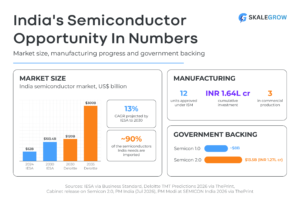
- Market size: According to IESA, the Indian semiconductor market was worth $52 billion in 2024 and is expected to reach $103.4 billion by 2030, growing at a 13% CAGR. Deloitte is even more bullish. Its estimate puts the market at $120 billion by 2030 and $300 billion by 2035. This is while noting that India still imports close to 90% of the semiconductors it needs (Sources: Business Standard, ThePrint).
- Manufacturing projects: 12 semiconductor manufacturing units have been approved under the India Semiconductor Mission, with cumulative investments of over INR 1.64 lakh crore. Three of them (Micron, Kaynes and CG Semi) have started commercial production (the first was Micron’s ATMP facility in Sanand, inaugurated on February 28, 2026). In July 2026, the government approved Semicon 2.0, the mission’s second phase, with an outlay of INR 1.27 lakh crore (Source: Prime Minister of India).
- Government backing: At SEMICON India 2026 earlier this month, PM Modi said the second phase of the India Semiconductor Mission would have an outlay of $13.5 billion, compared to $8 billion in the first phase (Source: ThePrint).
These numbers tell us one thing. Money, policy support, and global attention are all flowing into Indian semiconductors. But from what I have seen, most companies riding this wave are putting very little effort into marketing. Engineering gets the budget, sales gets the headcount, and marketing is left with an outdated website and a LinkedIn page that was last updated six months ago.
That is a missed opportunity. In the upcoming sections, let us understand why.
What will your buyers see when they look you up online?
Don’t get me wrong here. Tradeshows, referrals, and personal relationships still play a big role in how semiconductor buyers discover vendors. I strongly believe that semiconductor businesses need to continue doing that.
What I am saying is that discovery is only the first step. After a buyer meets you at a booth or hears your name from a peer, they go back and do their own research. And that research shapes their decision a lot more than most companies realize.
The 2025 Buyer Experience Report by 6sense makes this very clear. It found that 94% of buying groups had already ranked their preferred vendors before contacting anyone, and they went on to buy from that early favorite 77% of the time. In other words, by the time your sales team gets on a call, the buyer has most likely made up their mind (Source: 6sense).
There is another shift that is happening. 6sense also found that 94% of buyers now use LLMs like ChatGPT and Claude at some point in their buying journey. So, it is no longer just Google that decides what buyers find about you.
While these numbers are not specific to the semiconductor industry, there is a growing trend of more and more potential buyers researching businesses and potential suppliers online. The fact is that the buying committee is getting younger and more tech-savvy. This requires you to have a polished digital presence that can create a good first impression, however good your product or engineering capabilities are.
Now think about what happens after a tradeshow. A procurement head meets you at your booth, picks up your brochure, and flies back. A week later, when their team starts shortlisting vendors, what do they do? They visit your website. They check your LinkedIn page. They might even ask ChatGPT to compare you with two other vendors. If what they find doesn’t match the impression you created at the booth, you lose ground without ever knowing it.
In essence, if you are not designing your digital channels for easy discovery, you will soon fall behind. You don’t want your competitors to get ahead of you in that journey.
How you tell your story matters
Semiconductor companies love talking about specs, process nodes, and certifications. There is nothing wrong with that. Your technical capabilities are what you sell after all.
The problem is that the buying decision is rarely made by engineers alone. According to 6sense, buying committees average around 10 people. That includes procurement, finance, and business leadership, along with the technical team. The CTO wants to know if you can do the job. The CFO wants to know if it’s worth the money. The business head wants to know if you can help them get to market faster.
Let me give you an example. Here is a line you will find on many chip design services websites:
“We offer end-to-end physical design, DFT, and verification services across 28nm to 3nm nodes.”
Now compare it with this:
“We help chip companies tape out faster with fewer respins, backed by a team that has delivered designs from 28nm all the way to 3nm.”
The engineer on the buying team will for sure appreciate the first version. But the second one speaks to everyone in the room. It talks about what the customer gets, and still shows technical depth.
Essentially, your story needs to work for both the engineer and the executive. If it only speaks to one of them, you are leaving the other half of the committee to form their own opinions.
Brand perception can win (or lose) you deals
In semiconductors, switching suppliers is expensive and risky. Qualification cycles are long, and a wrong choice can delay a product launch by months. So naturally, buyers look for every possible signal of stability and credibility before they commit.
Rightly or wrongly, a lot of these signals come from your brand. Here are a few that buyers pay attention to the most:
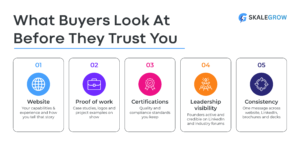
- Your website: Does it look current? Does it clearly explain what you do and who you do it for?
- Proof of work: Do you have case studies, customer logos, or project examples buyers can see?
- Certifications and quality standards: Are they relevant and visible?
- Leadership visibility: Are your founders and senior leaders active and credible on platforms like LinkedIn and contributing to the industry through talks at conferences and industry forums?
- Consistency: Does your messaging on the website, LinkedIn, brochures, and sales decks say the same thing?
This matters even more for Indian companies targeting customers in the US, Europe, or Japan. These buyers might never visit your facility. For them, your brand is often the closest thing to a first impression. An outdated website or an inactive LinkedIn page raises doubts well before anyone gets on a call.
Your digital presence is a booth that never closes
A tradeshow lasts three days. Your website, LinkedIn page, and search presence work for you all 365 days of the year.
If I had to pick the absolute essentials for a semiconductor company’s digital presence, here is what they would be:
- Website: Clear messaging, well-structured solution or capability pages, and easy ways to get in touch.
- SEO: Ranking for the terms your buyers search for. In a niche industry like semiconductors, the search volumes are small, but the intent is very high.
- LinkedIn: An active company page along with consistent posting from founders and technical leaders.
- AI search visibility: Making sure your company shows up when buyers ask ChatGPT, Gemini, or Perplexity about vendors in your space. Many in our community of B2B marketers are already asking how to do this, and I expect it to become a standard part of marketing very soon.
Engineers buy from people who know their stuff
Engineers are some of the most skeptical buyers I know. Fluff doesn’t work on them. Fancy taglines and stock photos of glowing circuit boards don’t impress them either.
What does work is content that helps them understand a problem better or solve it faster. That’s where thought leadership comes in. Here are examples of a few formats that work well in the semiconductor industry are:
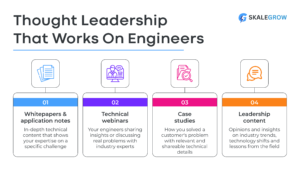
- Whitepapers and application notes: In-depth technical content that shows your expertise on a specific challenge.
- Technical webinars: Sessions where your engineers share insights or discuss real problems with industry experts or customers.
- Case studies: Stories of how you solved a customer’s problem with relevant details.
- LinkedIn content from senior leadership: Opinions and insights on industry trends, technology shifts, and lessons from the field.
When your content consistently helps engineers do their jobs better, you become the company they think of first. And as we saw earlier, being the early favorite is what wins most deals.
The crowd is only getting bigger
In one of my earlier articles, I said that attention is the new oil. That applies to the semiconductor industry more than ever right now.
The competition is growing from all sides. Global players are expanding their presence in India. At SEMICON India 2026 alone, Applied Materials announced $5 billion in investments over the next decade. At the same time, the government is providing design infrastructure support to 315 academic institutions and 104 startups, which means a whole new generation of Indian semiconductor companies is on its way (Source: Business Standard, ThePrint).
When a market is new, even average marketing can get you noticed. When it gets crowded, only the companies that are loud and consistent get remembered.
And consistency is where most semiconductor companies struggle. It is very common to see a company post ten times in the month before a big event and then go silent for the rest of the year. That doesn’t build a brand. What builds a brand is showing up every week with something useful to say, whether or not there is an event around the corner.
One channel is not enough
Most semiconductor companies rely on one or two channels, usually events and direct sales. The problem is that your buyers are spread across multiple channels, and so is their attention.
A multi-channel approach means your events, LinkedIn, email, website, SEO, and content all work together and support each other. Tradeshows are the best example of how this works.
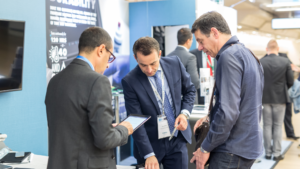
SEMICON India 2026 brought together more than 500 exhibitors, about half of them international, along with delegates from over 40 countries. In a crowd like that, simply putting up a booth is no guarantee that the right people will notice you. Here is what a multi-channel approach should look like when it comes to event and tradeshow marketing:
- Before the event: Announce your participation on LinkedIn, send email invites to prospects and customers, and book meetings in advance.
- During the event: Share live updates, record short videos with your team and visitors, and capture leads properly.
- After the event: Follow up with every lead within a week, repurpose the videos and insights into content, and nurture the contacts through email.
This way, one event gives you months of content and pipeline instead of three days of footfall.
Marketing helps you hire too
This is something most semiconductor leaders don’t think about when they think of marketing. As new fabs and OSAT units ramp up, the competition for skilled engineers is going to get very intense.
Engineers also research companies before they apply or accept an offer. A company with a visible brand, an active LinkedIn presence, and leaders who share their knowledge publicly has a clear edge in attracting talent. In essence, the same marketing that builds trust with customers also makes you a place people want to work at.
Where do you start?
If you are a semiconductor company that has not invested much in marketing so far, here are four things you can start with:
- Fix your website story: Rewrite your home page and capability pages so they speak to both technical and business stakeholders.
- Get active on LinkedIn: Start posting consistently from your company page, and more importantly, from the profiles of your founders and technical leaders.
- Publish one strong technical asset: A whitepaper, application note, or detailed case study that you can use across channels for months.
- Treat your next tradeshow as a campaign: Plan for before, during, and after, instead of just showing up with a booth.
You don’t need to do everything at once. Start with what you can do consistently, and build from there.
Final words
Let’s go back to the line I started with: “Our buyers are engineers. They don’t really care about marketing.”
The truth is, engineers may not care about marketing. But they care a lot about what they find when they look you up. And so does everyone else on the buying committee. Relationships and tradeshows will continue to matter in the semiconductor industry. But in a market that is booming and getting more crowded by the day, the companies that market well will be the ones buyers already favor before the first call.
If you are a semiconductor company looking to build your brand and generate more pipeline with marketing, please feel free to reach out to me over DM or write to us at info@skalegrow.com.
About the author

Naseef KPO is the Founder and CEO of Skalegrow. He comes with rich experience across multiple areas of B2B marketing including content marketing, demand generation, SEO, account-based marketing, marketing analytics, revenue attribution, marketing technology, etc. He writes thought-provoking and relevant articles on The Skalegrow Blog and his weekly LinkedIn newsletter Elevate Your Marketing.
Prior to starting Skalegrow, Naseef led large marketing teams in multi-million dollar B2B organizations where he made significant contributions to the topline growth of the business. He has also appeared on numerous podcasts where he shared his thoughts on trending marketing topics such as the application of AI in marketing, startup marketing, ABM, and B2B content marketing, just to name a few. Being the founder of Skalegrow, he is currently focusing on helping its clients stay ahead of their competition by using innovative yet practical marketing tactics.
You can connect with Naseef KPO on LinkedIn.
About Skalegrow
Skalegrow is a B2B marketing agency that helps companies in the semiconductor, IT, SaaS, manufacturing, and robotics industries grow with marketing. Our services include content marketing, SEO, video marketing, email marketing, graphic design, LinkedIn marketing, branding, presentation design, and website development. Feel free to check out our website to learn more about who we are and what we do.








 your marketing
  new-age tactics?