

Most B2B positioning statements get written once, approved in a meeting, and then forgotten about. Someone comes up with a line, everyone agrees it sounds good, it goes into the brand deck, and that’s usually where the process ends. Very few teams go back later and ask whether the statement still makes sense outside that meeting room.
That’s the part that needs more attention. Getting everyone internally to agree on a positioning statement doesn’t mean it has actually been tested. It just means the people in the room liked it. That can become a costly assumption when buyers are considering several companies making claims that sound nearly the same.
This piece looks at how to properly analyze and test B2B brand positioning. It covers how to review what you already have, how to put the positioning statement in front of actual buyers, what to do with the feedback you get, and how to revisit it over time instead of treating it as something that’s finished forever.
What a positioning statement is actually for
A positioning statement is something the company uses internally. It isn’t meant to be customer-facing copy. It sets out who you’re trying to reach, what problem you’re solving, the space you want to compete in, and why someone should choose you over the other options. It’s different from a tagline or homepage headline. Those should come later, based on the positioning.
A good positioning statement gives everyone the same starting point. The website, sales deck, and what a sales rep says to a prospect should all come from the same idea. If they’re all describing the company in completely different ways, that’s usually a sign that the positioning hasn’t been worked through or tested enough.
Phase one: run a positioning analysis before you test anything
Before you put your positioning statement in front of buyers, take a proper look at what they’re actually seeing from your company today. A positioning analysis is really just a way of checking whether what you meant to say is the same as what’s making its way into the market.
Start by pulling together the things a potential buyer is likely to see: your website, sales deck, recent case studies, email sequences, and a few review site profiles. Then go through them one by one and ask yourself a few questions:
- Does this piece of content make the same core claim as the positioning statement, or a slightly different one?
- Does it name the same target buyer, or a broader one?
- Does it lean on proof, or on adjectives no one can verify?
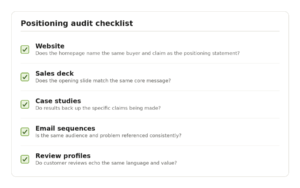
You’ll often notice this just by putting the different pieces side by side. The positioning statement says “mid-market logistics teams.” The homepage says “growing businesses.” Then the sales deck talks about “operations leaders.” Maybe they’re all trying to describe the same audience, but it doesn’t read that way. A buyer looking at all three could easily be left wondering who the company is actually trying to reach.
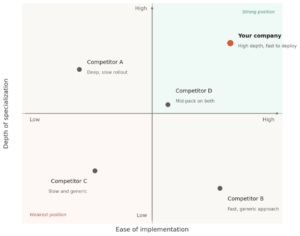
This is also a good point to look at the competition. Pick three to five direct competitors and see what they’re saying, who they’re speaking to, and what evidence they use to back it up. A simple two-axis matrix can make the differences easier to see. Plot your company alongside competitors using the two factors buyers care about most when making a choice. If everyone ends up in roughly the same spot, you may have a differentiation problem before you’ve even started talking to buyers.
Phase two: test the positioning statement with real buyers
Once you’ve looked through the existing material, the next step is to see how the positioning itself comes across to someone outside the company. You’re testing the statement here, not the marketing built around it.
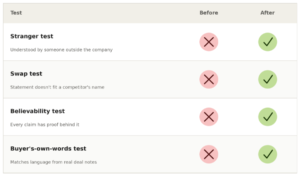
The stranger test. Show the positioning statement, or even just the homepage, to someone who fits your target buyer but doesn’t know the company. Then ask them what they think the company does, who they think it’s meant for, and why they would choose it over another option. Pay attention to what they can and can’t explain. If they understand which category the company belongs to but can’t explain what makes it worth choosing, the positioning may describe what the company does without giving the buyer much reason to care.
The swap test. Take your positioning statement and swap in a competitor’s name. If it still reads true, it isn’t a positioning statement; it’s a category description. Most statements fail this test the first time they’re tried because phrases like “the platform teams love to use” are never specific enough to belong to one company.
The believability test. Go claim by claim and ask yourself: can we actually prove this? If the answer is no, that’s a problem. Buyers can check your claims for themselves, whether that’s through reviews, conversations with other people in the industry, or just a bit of research. If they can’t find anything to back up what you’re saying, they have little reason to believe it.
The buyer’s-own-words test. Go back through the last ten to fifteen deals you won and lost. Look at the call notes and emails. If possible, talk to a few of those buyers again. What made them hesitate? What made them say yes? What would they tell someone else who was looking at the same options? Put those answers next to your positioning statement and see how closely they match. If they’re talking about the same things, that’s a good sign. If they aren’t, you may be emphasizing something buyers don’t really care about or missing the language they use when they have to explain their choice to someone else.
A quick reference for what each test is actually checking:
| Test | What it checks | What a failure looks like |
| Stranger test | Whether someone outside the company understands it | The buyer gets what category you’re in but not why they should choose you |
| Swap test | Whether the statement actually sets you apart | You could put a competitor’s name in the statement and it would still make sense |
| Believability test | Whether there’s proof behind the claims | The statement uses adjectives instead of anything that backs them up |
| Buyer’s-own-words test | Whether the statement reflects how buyers actually talk about the decision | The positioning says one thing, while deal notes point to completely different reasons for buying |
Do this with people who actually fit your buyer profile, not just people you know who are likely to give you a positive answer. Start with open questions before showing them your positioning, so you can hear what they come up with on their own. And don’t change the statement based on one or two conversations. Wait until you’ve spoken to at least five people and you start hearing the same things more than once. One strong reaction, whether it’s positive or negative, doesn’t tell you much on its own.
Phase three: refine based on what the evidence shows
Refining a positioning statement rarely means starting from a blank page. In most cases, the testing and analysis point to one of four specific fixes.
If buyers outside your ideal segment react just as well as the buyers you’re trying to reach, your audience may be too broad. It’s harder to make useful decisions when the target includes almost everyone. Narrowing it down can feel limiting at first, but it usually makes the rest of the positioning much clearer.
If buyers keep putting you in a different category than the one you chose, pay attention to that. They may be seeing something in the business that you hadn’t considered. It could mean the positioning needs to change to match how buyers already think about you. Or it could mean you’ve found a space that isn’t very crowded yet. If so, there may be more value in leaning into that than trying to convince people to see you differently.
If buyers understand the problem but aren’t convinced that your company can solve it, more convincing language probably won’t help. Show them something instead. A relevant case study, a real result, or a customer they recognize can make the point much better than adding another word like “leading” or “powerful.”
If the swap test keeps failing even after several rewrites, the “why us” part probably needs more work. There should be something there that a competitor can’t easily say about themselves. Maybe you know a particular type of customer unusually well, have a different way of delivering the work, or have results that competitors can’t point to.

Don’t rewrite the whole thing every time someone gives you feedback. Once the positioning has been tested properly and you know it reflects something real, it should be able to stay in place for a while. If you’re completely changing it every few months, the problem may be bigger than the wording. You probably haven’t settled the underlying positioning yet.
Phase four: keep the analysis running
A positioning analysis isn’t something you can finish and forget about. What buyers care about can change. Competitors can change how they talk about themselves. The category can change too. So even if a positioning statement tested well two years ago, there’s no guarantee it still works the same way today. The problem is that this can be easy to miss. You may not realize anything has changed until you start seeing fewer wins or deals taking longer to close.
You don’t have to revisit everything all the time. Checking the competitive matrix twice a year is a good start. It’s also worth speaking to a few buyers again if you launch something significant, a new competitor comes along, or you notice that deals are moving differently than they used to. Keep a note of what changed and why. It makes it much easier to look back later and understand how you got there.
Your win-loss data is useful here too. Every deal tells you a little more about whether the positioning still makes sense to buyers. Keep looking at those patterns as they build up. That’s a lot more useful than doing a round of buyer interviews once and assuming the positioning will stay relevant forever.
Mistakes worth avoiding
Testing only with happy customers is the most common mistake. They have already chosen you, so your positioning statement naturally makes sense to them. The buyers who almost didn’t choose you or chose a competitor instead are far more valuable to talk to.
Treating one round of feedback as the final answer is another mistake. Buyers don’t always use the same language forever. As a market changes, the way people talk about their problems changes with it. Something that tested well eighteen months ago might not have the same impact now, especially if competitors have started making similar claims or the problem itself has changed.
The other mistake is putting too much weight on how well the statement is written. A positioning statement can sound great and still fall apart when you actually test it. If it isn’t specific, believable, or difficult for competitors to say themselves, good writing isn’t going to fix that. Testing gives you a chance to find this out before it becomes a sales problem.
A B2B positioning statement has to work with people outside the company, not just inside it. Go back to the buyers, see what they actually think, and make changes based on what keeps coming up. Then keep checking it as things change. When you do that, the statement becomes more than something sitting in a brand deck. It gives the sales, marketing, and product teams something solid to work from.
FAQs
- What’s the difference between a positioning statement and a tagline?
A positioning statement is an internal document defining your audience, problem, and differentiator. A tagline is customer-facing copy written from that positioning, not the other way around. - How often should you test a B2B positioning statement?
Revisit the competitive matrix twice a year, and re-test with buyers after a major product change, a new competitor, or a shift in win rate. - How many buyers do you need to talk to before trusting the results?
At least five conversations showing the same pattern. One strong reaction, positive or negative, isn’t a reliable signal. - What’s the fastest way to check if a positioning statement is actually differentiated?
Run the swap test: drop a competitor’s name into the statement. If it still reads true, it’s a category description, not real positioning. - Should you only test positioning with happy customers?
No. Happy customers already agree with you by default. Buyers who almost didn’t choose you, or chose a competitor, give far more useful feedback.








 your marketing
  new-age tactics?